WHMIS Grace Period Is Over — Is Your Facility Still Compliant?
The WHMIS transition deadline passed December 14, 2025 — no extensions, no exceptions. Health Canada has published new hazardous substance assessments for five common industrial chemicals and retains full authority to enforce compliance today. Here's what Canadian industrial facilities need to check before their next inspection.
📰 News Insight
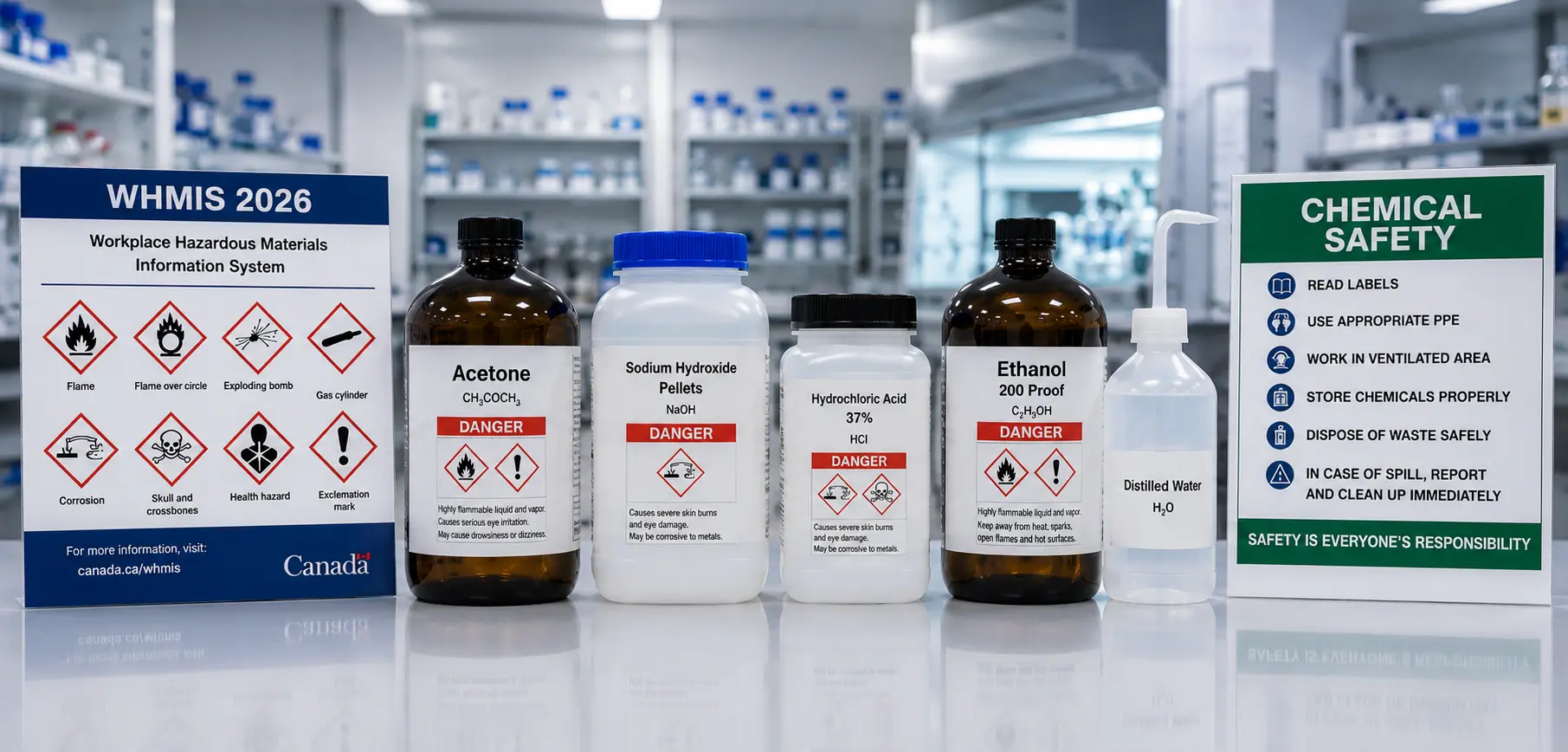
Health Canada published its March 2026 WHMIS Program Newsletter on March 31, confirming two actionable developments for industrial workplaces. New hazardous substance assessments are now available for benzyl alcohol, citric acid, hydrochloric acid, hydrogen peroxide, and sodium hypochlorite — five substances common across industrial, cleaning, and processing environments. Separately, in Canada, the 3-year transition period for updating product classifications, safety data sheets, and labels to comply with the amended Hazardous Products Regulations ended on December 14, 2025 — all hazardous products in Canada are now required to be fully compliant with the amended HPR.

💡 What It Means for Industrial Safety Distributors Across Canada
This is a compliance enforcement signal dressed up as a newsletter update — and most distributor clients will miss it entirely.
Here's what matters operationally: the WHMIS transition grace period is over. As of December 14, 2025, there is no more runway. Every hazardous product on a Canadian worksite — cleaning agents, industrial chemicals, processing compounds — must now have fully compliant safety data sheets and labels under the amended Hazardous Products Regulations. Health Canada retains the authority to take measures to induce or compel compliance at any time with the HPR, if warranted.
The five newly published hazardous substance assessments are a direct signal of where Health Canada's compliance focus is landing — hydrogen peroxide, hydrochloric acid, and sodium hypochlorite are staples in food processing, metal fabrication, water treatment, and industrial cleaning operations. Facilities using these substances that haven't updated their SDS documentation and labeling are now in active non-compliance.
For distributors, this creates two distinct sales conversations:
1. WHMIS compliance product sales — updated labels, SDS binders, chemical storage cabinets, secondary containment products, spill kits, and chemical-resistant PPE (gloves, aprons, face shields) for the five newly assessed substances.
2. WHMIS training upsell — many distributor clients offer or partner on safety training. Newly compliant SDSs require worker re-training on updated hazard classifications. This is a service-layer opportunity on top of the product sale.
Key sectors most exposed: food and beverage processing (AB, MB, SK), metal fabrication (ON, AB), industrial cleaning contractors (all provinces), water treatment facilities (all provinces).